 Return to Online
Library listing
Return to Online
Library listing Return to Online
Library listing
Return to Online
Library listing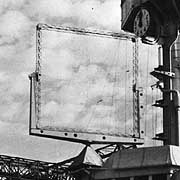
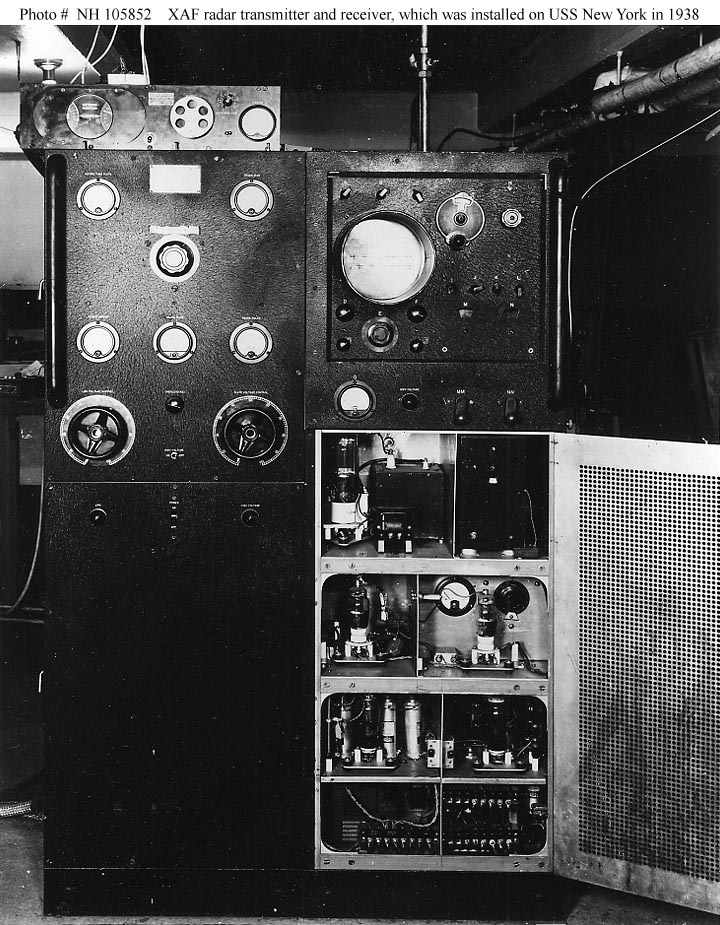
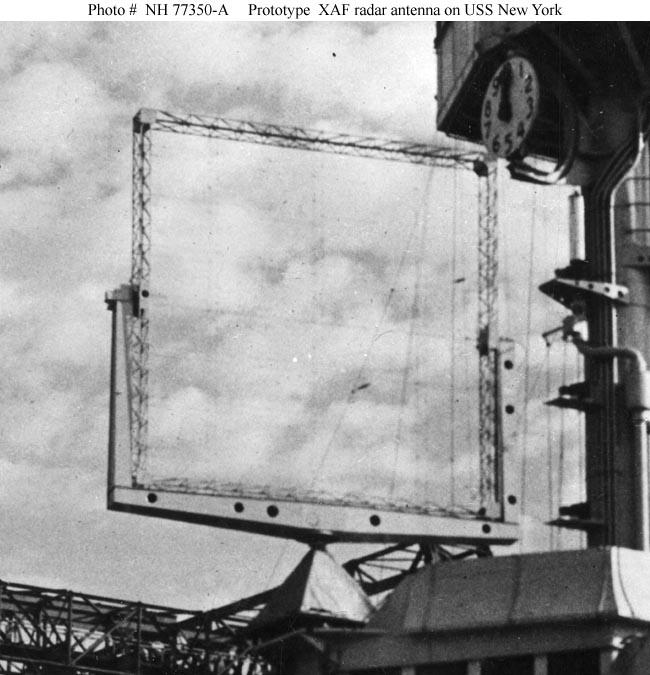
The "XAF", an experimental radar that resulted from several years' technical progress by the Naval Research Laboratory (NRL), was constructed in 1938, following a late February decision to install a radar set on a major warship. Operating at 200 megacycles (1.5 meter wavelength) at a power of 15 kilowatts, the XAF featured a "bedspring"-like antenna about 17 feet square. This was mounted in a rotating yoke that allowed it to scan around the horizon, and to elevate for what was hoped would be improved aircraft detection. This large antenna and yoke had to be strong enough for sea service, while remaining as light as possible to avoid excessive topside weight. Accordingly, the Brewster Aeronautical Corporation (then also building the Navy's first monoplane shipboard fighter, the F2A "Buffalo"), was given the job of fabricating a suitable duralumin structure. The XAF's transmitter, receiver and other equipment were made by NRL.
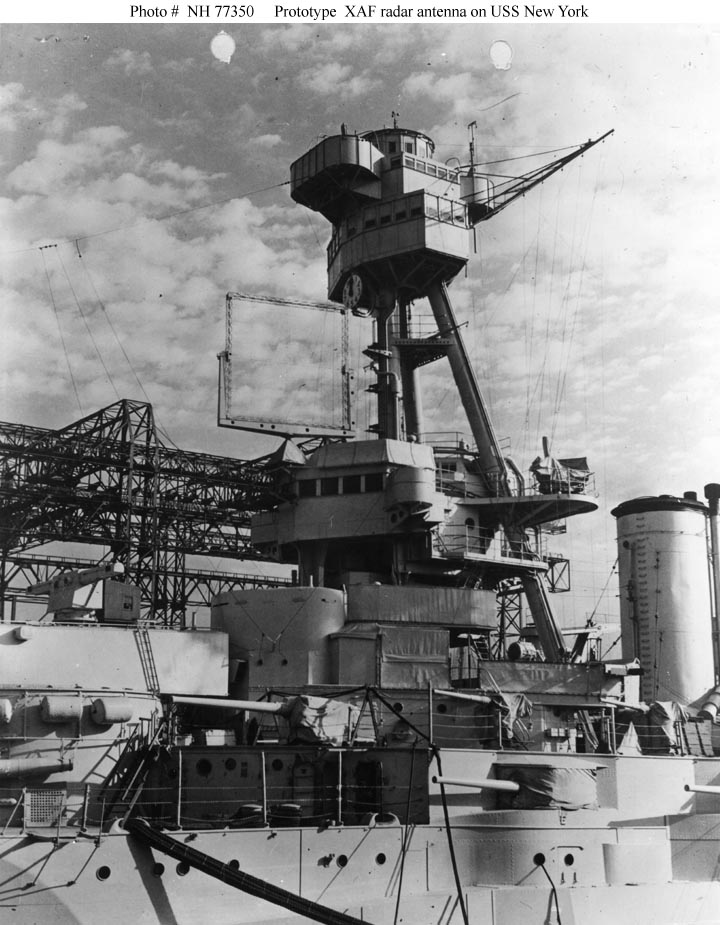
When development and construction were complete, the XAF was installed on the battleship New York. This work, with the antenna mounted atop the pilothouse (where it displaced a large rangefinder -- moved to the top of the ship's Number Two 14-inch gun turret) was completed in December 1938. During nearly three months of constant operation, averaging almost twenty hours daily as New York participated in winter maneuvers and battle practice in the Caribbean, the XAF's performance and reliability exceeded expectations. It detected aircraft up to 100 nautical miles (nm) away and ships out to 15 nm. The radar was also employed for navigation and in gunnery practice, spotting the fall of shot and even tracking projectiles in flight.
At the conclusion of these tests, New York's Commanding Officer recommended installation of radar in all aircraft carriers (whose vulnerability to surprise air attack was very well-understood), while the Commander of the Atlantic Squadron commented "The XAF equipment is one of the most important military developments since the advent of radio ...". Later in 1939, the XAF was reengineered and placed in production by the Radio Corporation of America. Designated CXAM, six of these production models were delivered in 1940 and installed on an aircraft carrier, a battleship and four cruisers. An improved version, CXAM-1, with a simplified antenna, was produced in greater numbers. By the time the United States entered World War II in December 1941, the use of radar in the U.S. Navy was rapidly expanding.
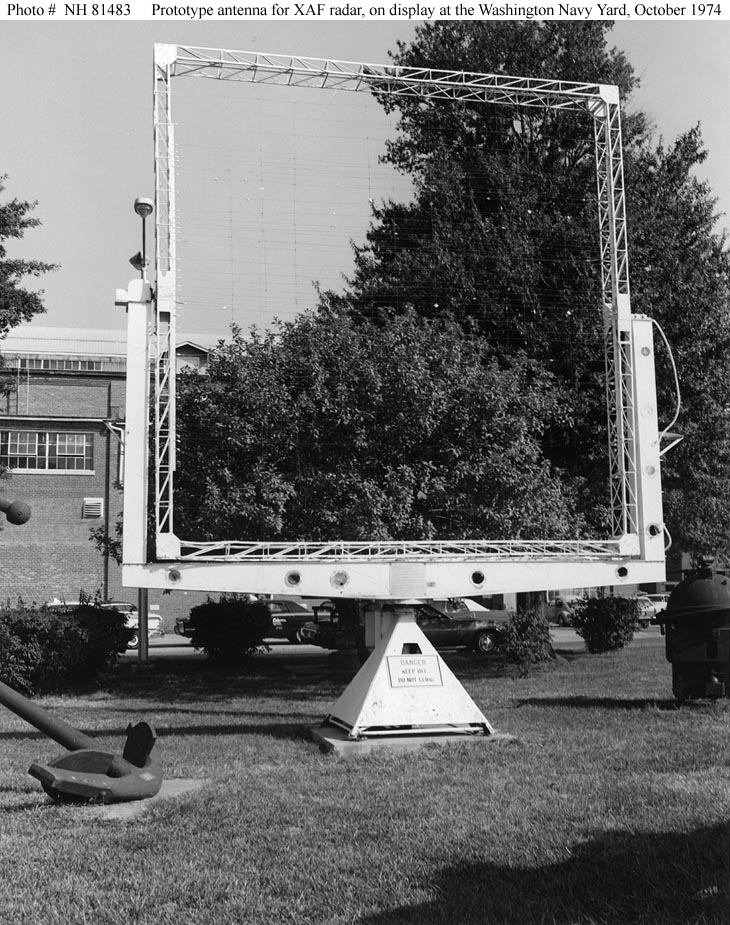
The XAF radar's antenna survived World War II as a historic artifact. For several decades in the middle and later Twentieth Century it was exhibited in Willard Park, close to the Washington Navy Yard's waterfront. However, the outdoor environment contributed to serious deterioration in the antenna's condition, and it was placed in storage in the mid-1990s. In May 2008 it was loaned to the Historical Electronics Museum, located in Linthicum, Maryland, where it is to be restored and again placed on public exhibit.
Source note: Most of the information in this text is taken from the following sources: Captain L.S. Howeth, USN: History of Communications-Electronics in the United States Navy, Chapter XXXVIII (Washington, D.C., 1963); and Norman Friedman: Naval Radar (Greenwich, England, 1981).
This page provides all the images we have concerning the
U.S. Navy XAF type radar of 1938.
For additional information on World War II era radar, see the Navy Department Library's
"Online Reading Room" presentation:
| If you want higher resolution reproductions than the digital images presented here, see: "How to Obtain Photographic Reproductions." |
Click on the small photograph to prompt a larger view of the same image.
|
Photo #: NH 105852 XAF Radar (Transmitter and Receiver) Which was installed on USS New York (BB-34) by the U.S. Naval Research Laboratory in late 1938. While mounted on that ship, this experimental 200 megacycle radar was tested at sea during the first months of 1939. Official U.S. Navy Photograph, from the collections of the Naval History and Heritage Command. Online Image: 184KB; 720 x 925 pixels |
 |
|
Photo #: NH 77350 USS New York (BB-34) View of the ship's forward superstructure, with the antenna of the XAF radar atop her pilot house, circa late 1938 or early 1939. A cropped version of this image, emphasizing the radar antenna, is Photo # NH 77350-A Note the battleship's foremast, with its gunfire control facilities; her armored conning tower; and the rangefinder atop her Number Two gun turret. U.S. Naval History and Heritage Command Photograph. Online Image: 120KB; 720 x 925 pixels |
 |
|
Photo #: NH 77350-A Antenna of the XAF radar On USS New York (BB-34), circa 1938-1939. This experimental 200-mc radar, developed by the Naval Research Laboratory, was installed atop New York's pilot house in late 1938 and underwent testing during the first months of 1939. Its light-weight duralumin structure was constructed by the Brewster Aeronautical Corporation. Note the round gunfire concentration dial, fitted below the battleship's foremast top, in the upper right of the image. This image is cropped from Photo # NH 77350. U.S. Naval History and Heritage Command Photograph. Online Image: 74KB; 650 x 675 pixels |
 |
|
Photo #: NH 81483 Antenna of the XAF radar On display in East Willard Park, Washington Navy Yard, D.C., in October 1974. The experimental XAF radar was developed by the Naval Research Laboratory and installed on USS New York (BB-34) in late 1938. For a view of this antenna on board New York, see Photo # NH 77350-A. U.S. Naval History and Heritage Command Photograph. Online Image: 182KB; 730 x 925 pixels |
 |
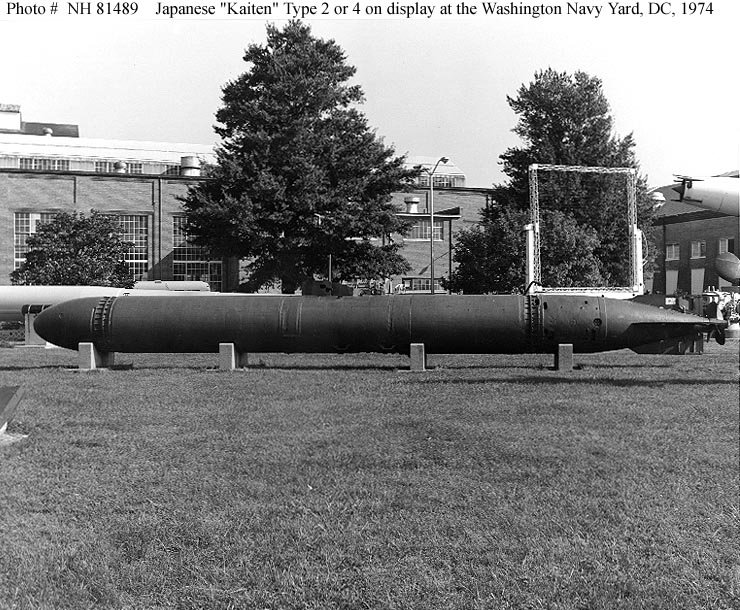
The antenna of the XAF radar is visible in the right background
of the following photograph of another subject
(note that it is not specificially identified in that photograph's
caption):
|
Photo #: NH 81489 Japanese "Kaiten" (Type 2 or Type 4) Human Torpedo On display in East Willard Park, Washington Navy Yard, Washington, D.C., in October 1974. This example is 54 1/2 feet long and 4 1/2 feet in diameter. It was built in 1945. U.S. Naval History and Heritage Command Photograph. Online Image: 147KB; 740 x 610 pixels |
 |
ADDITIONAL VIEWS: The XAF radar's antenna is distantly
visible in several aerial photographs of the Washington
Navy Yard, taken during the 1970s. Though it is not mentioned
in these photos' captions, it can be readily spotted because the
antenna's light paint and distinctive shape stands out against
a background of dark foliage:
NOTES:
| If you want higher resolution reproductions than the digital images presented here, see: "How to Obtain Photographic Reproductions." |
 Return
to Naval History and Heritage Command home page.
Return
to Naval History and Heritage Command home page.Page made 9 June 2008
Coding updated 11 May 2009