 Return
to Online Library listing
Return
to Online Library listing
 Return
to Online Library listing
Return
to Online Library listing
Having failed to defend adequately against the Inchon Invasion in mid-September 1950, the North Koreans were not to be caught twice in that kind of trap. Their Soviet supporters had provided thousands of sea mines, plus technical advisors, and these began to show their effectiveness in late September as several U.S. and South Korean Navy ships struck mines off the Korean east coast, with some vessels being sunk. However, much worse was to come as the small available minesweeping force began to clear Wonsan's approaches in preparation for the forthcoming landings.
Mines were expected off Wonsan, and clearance operations began on 10 October, ten days before the planned amphibious assault. The first two days' work was encouraging, with the minesweepers receiving assistance from helicopter spotters, Underwater Demolition Team (UDT) personnel and experiments in detonating mines with bombs dropped by carrier planes. Then, on 12 October things quickly went sour as USS Pirate (AM-275) and USS Pledge (AM-277) hit mines and sank, with the Wonsan shore batteries joining in to increase the misery. With two precious ships gone, the practice of safe minesweeping became essential, slowing progress considerably.
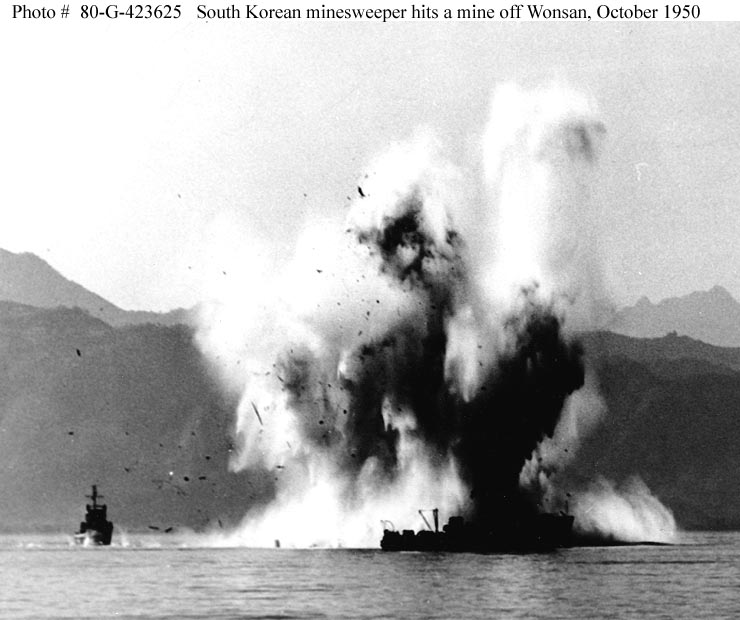
However, clearance activities were still on schedule, when on 18 October, magnetic mines were discovered the hard way as South Korean YMS-516 was destroyed while conducting a check sweep off the invasion beaches. That forced a postponement of landings from 20 to 26 October, while putting the surviving minesweepers and the UDT members to a great deal more difficult work, work that continued around Wonsan through October and well into November.
Fortunately for the UN forces, the situation ashore was so favorable that the delay was no more than embarassing. The U.S. Navy, though, immediately recognizing how a major disaster could easily have resulted, began an urgent effort to enlarge and improve its counter-mine capabilities. The Wonsan lesson, received at the hands of a minor power using relatively inexpensive means, were taken to heart by contemporary Navy policy makers. They must never be forgotten by those whose missions include the application of power from the sea.
This page features overall views of mine clearance operations off Wonsan, and provides links to more pictures of those activities.
For additional coverage of Wonsan mine clearance operations,
see:
For a special image selection on the Wonsan Landings, plus
links to additional pictures of that operation, see:
For views of other aspects of the September-November United
Nations' offensive in Korea, see:
For a precis of our Korean War images, and links to more
comprehensive pictorial coverage of that conflict, see:
If you want higher resolution reproductions than the Online Library's digital images, see: "How to Obtain Photographic Reproductions."
Click on the small photograph to prompt a larger view of the same image.
|
Photo #: NH 97054 Wonsan Operation, October 1950 U.S. Navy Auxiliary Minesweepers (AMS) clearing a channel through a minefield, off Wonsan, North Korea, 12 October 1950. Official U.S. Navy Photograph, from the collections of the Naval Historical Center. Online Image: 122KB; 740 x 620 pixels |
 |
|
Photo #: 80-G-422245 Opening of Wonsan, October 1950 AMS-type minesweepers at work in Wonsan harbor, Korea, October 1950. The original photo is dated 12 October 1950. Minesweeping had begun there on 10 October. Official U.S. Navy Photograph, now in the collections of the National Archives. Online Image: 120KB; 740 x 610 pixels Reproductions of this image may also be available through the National Archives photographic reproduction system. |
 |
|
Photo #: 80-G-423625 Opening of Wonsan, October 1950 Republic of Korea minesweeper YMS-516 is blown up by a magnetic mine, during sweeping operations west of Kalma Pando, Wonsan harbor, on 18 October 1950. This ship was originally the U.S. Navy's YMS-148, which had served in the British Navy in 1943-46. Official U.S. Navy Photograph, now in the collections of the National Archives. Online Image: 66KB; 740 x 620 pixels Reproductions of this image may also be available through the National Archives photographic reproduction system. |
 |
|
Photo #: 80-G-443316 Opening of Wonsan, October 1950 Republic of Korea minesweeper YMS-516 sinking in Wonsan harbor, 18 October 1950, after she detonated a magnetic mine during sweeping operations west of Kalma Pando. USS Redhead (AMS-34) is just to the right of the sinking ship, rescuing survivors, as is another minesweeper to the left. Photographed from USS Merganser (AMS-26). ROK YMS-516 was originally the U.S. Navy's YMS-148, which had served in the British Navy in 1943-46. Official U.S. Navy Photograph, now in the collections of the National Archives. Online Image: 73KB; 740 x 605 pixels Reproductions of this image may also be available through the National Archives photographic reproduction system. |
 |
|
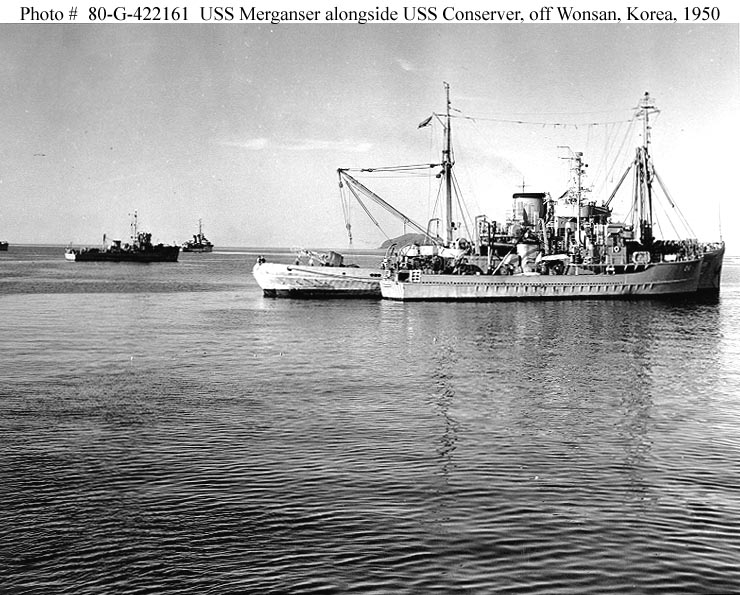
Photo #: 80-G-422161 Opening of Wonsan, October 1950 USS Merganser (AMS-26) tied up to USS Conserver (ARS-39) in Wonsan Harbor, Korea. Photographed by AFAN W.C. Newbill. The original photo is dated 23 October 1950. Note navigation bouy on Conserver's after deck and ships in background, including another AMS and a high-speed minesweeper (DMS). Official U.S. Navy Photograph, now in the collections of the National Archives. Online Image: 116KB; 740 x 595 pixels Reproductions of this image may also be available through the National Archives photographic reproduction system. |
 |
|
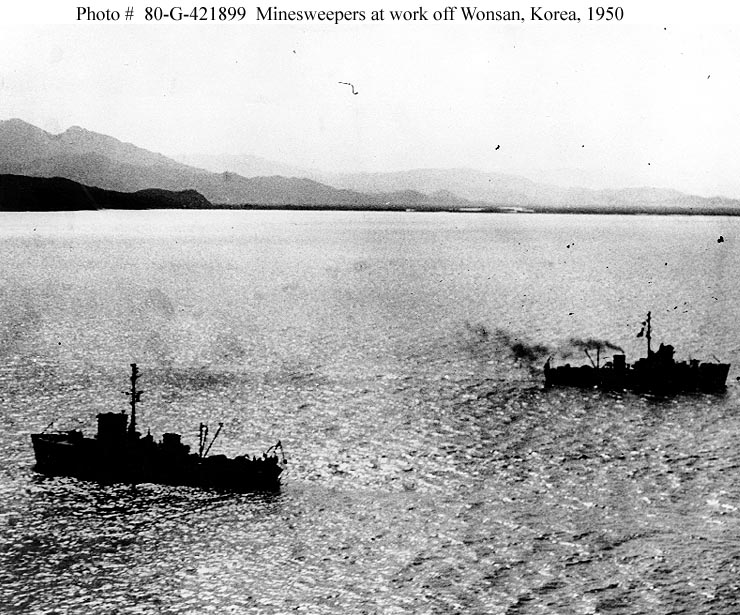
Photo #: 80-G-421899 Opening of Wonsan, October 1950 Two U.S. Navy minesweepers (AMS) at work off Wonsan, Korea. The original photo is dated 24 October 1950. Official U.S. Navy Photograph, now in the collections of the National Archives. Online Image: 122KB; 740 x 615 pixels Reproductions of this image may also be available through the National Archives photographic reproduction system. |
 |
For additional coverage of Wonsan mine clearance operations,
see:
For a special image selection on the Wonsan Landings, plus
links to additional pictures of that operation, see:
For views of other aspects of the September-November United
Nations' offensive in Korea, see:
For a precis of our Korean War images, and links to more
comprehensive pictorial coverage of that conflict, see:
If you want higher resolution reproductions than the Online Library's digital images, see: "How to Obtain Photographic Reproductions."
 Return to Naval
Historical Center home page.
Return to Naval
Historical Center home page.Minor text corrections 10 November 2000